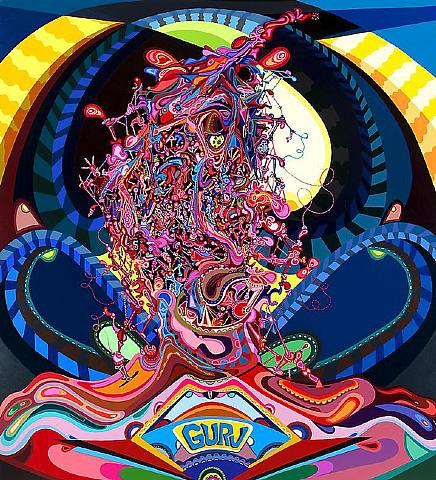
The positively down-tempo music of our good buddy-Mr. Zach Lipkins(a resident of Pdubz, USA)-has definitely cemented it’s place among the Bonobo’s and Thievery Corporation’s of the world on my “2-5am & and Thoughtfully Stoned” Itunes Playlist. For anyone who hasn’t gotten a chance to get down to some of Zach’s head-y jams, letss do diss!…
I might not have really paid notice to it so much when I first played his album, Air Whales, but I can’t help but feel good blasting some of these mind picking,organic-done-electronic tracks straight from Zach. I think this album is so soothing, it's gotten to the point where my ADD-esque mind is just fine with letting it play from end to end, if only it could get rid of this head cold.
After much deliberation, I think that Sebra has become that one most auspicious track that my mouse gravitates to initially on this tracklist. It starts off with the hollow sound of finger’s rubbing across a guitar fret, moves into some head bobbing soft break beat’s, and adds a little repeating synth progression. All the while, some of the sounds make me feel like I am inside of a freshly OCD-cleaned out Illadelph, or simply floating through something very fluid.
The one live show I was able to attend of Zach’s last year nearly blew me and the rest of the 20 Pratt crew right off our seats (yes, this was quiet, sit down show amongst scholars )…and into the quietest dance off ive ever been a part of. I am excited to catch his next show (TBA), which will hopefully include a longer set and some Gavin Castleton (Gruvis Malt) live vocals. I think someone should work on getting Zach to throwdown some late night sets in the near future, i got a few ill dance moves ready for that night.
PS. ask Zach how to get a copy of the album at zlipkins@gmail.com or at myspace.com/zachlipkins
The notion that most people’s minds’ cling to ideas, doctrines, words, and other such dependencies is indisputable. This spurs from a natural misunderstanding since conception of the world and life that surrounds us. Most would be unable to fathom, or put into practice for that matter, any notion that we are in fact able to reach out and understand the nature of our existence. Hui Neng’s Platform Sutra exposes the means in which anyone can develop the understanding that so many believe to be unattainable. In this paper I intend to explore the necessity of understanding one’s own mind and looking solely to it for progression toward Buddha hood; the pitfalls of the misidentified mind and the defilements of the impure mind; as well as the fundamental principle of non-attachment. The Sutra of Hui Neng represents the Sudden School and provides the reader with an alternative to traditional Buddhist teachings. Hui Neng’s Sutra connects Buddhism and Enlightenment intimately with the human’s most complex component, the mind. I hope to illustrate his understanding of one’s Essence of Mind, as well as his belief in its ultimate necessity within this essay.
“When he came to the sentence, ‘One should use one’s mind in such a way that it will be free from any attachment,’ I at once became thoroughly enlightened, and realized that all things in the universe are the Essence of Mind itself.” The moment in which Hui Neng attains sudden enlightenment through the Patriarch Hong Ren’s words exemplifies the importance of the principle of non-attachment to the Sutra. The myth of Hui Neng is meant to represent the life of a pure Buddha, and the single concept that spurred this pure Buddha’s enlightenment was that of non-attachment. By realizing that “all things are the manifestation of the Essence of Mind”; Hui Neng sees instantly that the mind is the instrument which must be utilized in order for enlightenment to be reached. He states in the forth chapter of his Platform Sutra: “If we allow our thoughts, past, present, and future, to link up in a series, we put ourselves under restraint. On the other hand, if we never let our mind attach to anything, we shall gain emancipation. For this reason, we take ‘non-attachment as our fundamental principle.” Any idea, such as the self or time, is simply a way for the mind to become attached, thus limiting the nature of one’s Essence of Mind. Hui Neng explains to his followers that one must practice ‘Idea-lessness’ in order to remain detached from all circumstances and avoid belief that there is anything to be attained in the Essence of Mind. Hui Neng states in the second chapter of the Sutra: “The capacity of the mind is as great as that of space. It is infinite, neither round nor square, neither great nor small, neither green nor yellow, neither red nor white, neither above nor below, neither long nor short, neither angry nor happy, neither right nor wrong, neither good nor evil, neither first nor last.” If all things in the universe are the Essence of Mind itself; there can be no idea or form used in which one can wrongfully limit its nature. Once you can see the mind with non-attachment, you can use the mind to connect to your Buddha nature. Hui Neng continues his argument in relation to Dhyana: “If we are attached to outer objects, our inner mind will be perturbed. When we are free from attachment to all outer objects, the mind will be in peace.” This practice of non-attachment is Dhyana, and Samadhi remains as the inner peace that is reached. One must be able to grasp this concept of non-attachment in order to realize the Essence of Mind. Enlightenment cannot be found if a person has found themselves trapped by the defilements of ignorant practice.
Zhi Chang was first taught by Master Da Tong the way to realize the Essence of Mind and attain Buddha hood, but had not yet become enlightened. In his explanation, Da Tong had confused Chang with the concepts of “Right View” and “True Knowledge.” When Zhi Chang came to Hui Neng to ask him of the true nature of the Essence of Mind, Hui Neng replied: “To let these arbitrary concepts rise spontaneously in your mind indicates that you have misidentified the Essence of Mind, and that you have not yet found the skillful means to realize it. If you realize for one moment that these arbitrary concepts are wrong, your own spiritual light will shine forth permanently.” Zhi Chang was unable to realize his Essence of Mind since his mind remained contaminated by ideas. The instant he believed that the Essence of Mind would not be found within the delusion of concepts of phenomena, Zhi Chang became enlightened. Chang remains as an example of how easily one can allow enlightenment to slip through their fingers. Even the teachings of a Zen master can defer your realization of Essence of Mind, through the smallest attachment. “It is because of the delusion under which our mind works that we fail to realize it (the Wisdom of Enlightenment) ourselves…There is no difference between an enlightened man and an ignorant one. What makes the difference is that one realizes it, while the other is ignorant of it.” This ignorance that Hui Neng speaks of is characteristic of anyone who is yet to realize the Essence of Mind. The enlightened man has not simply spoke about the Essence of Mind, as the ignorant man often does, but has used his mind to make such thoughts into reality. He does this by cutting ties with mere thoughts and delusions, and instead uses mental practice to see that the only nature that exists is Buddha nature. I really connected to this idea, because I find it much more comforting to believe that through mental practice one could become closer to understanding existence. “He who does not know his own Essence of Mind, and is under the delusion that Buddha hood can be attained by outward religious rites is called the slow-witted. He who knows the teaching of the Sudden School and attaches no importance to rituals and whose mind functions always under right views, so that he is absolutely free from defilements or contaminations, is said to have known his Essence of Mind.” Hui Neng stresses the fact that the teachings of Gradual School are merely defilements. Buddha hood cannot be attained without realizing one’s Essence of Mind. One cannot come to understand the Essence of Mind if they remain attached to any religious concepts or practice. The Essence of Mind cannot be found within any devout religious practice and cannot be understood by any ignorant person who does not realize that the pure mind is to be found within the impure mind itself.
In the opening lines of Hui Neng’s Platform Sutra he states: “Learned audience, our Essence of Mind which is the seed or kernel of enlightenment (Bodhi) is pure by nature, and making use of this mind alone we can reach Buddha hood directly.” Hui Neng explains here that there is only one place to look for enlightenment: within one’s self; and only one way to realize that enlightenment: through one’s mind. This is the meaning behind the entirety of Hui Neng’s Sutra. A person’s Essence of Mind is their true nature free from defilements associated with attachments. Every person, no matter who they are, has Buddha nature, but they must utilize their mind to understand that nature. When Fa Da comes to Hui Neng, he explains that he has recited the Lotus Sutra three thousand times and has yet to become enlightened. “The Patriarch replied, ‘Fa Da, the Law is quite clear; it is only your mind that is not clear.’” Hui Neng goes on to explain that: “You should therefore accept the interpretation that Buddha-knowledge is the Buddha-knowledge of your own mind and not that of any other Buddha.” He explains to Fa Da that there is nothing outside of your own mind that can assist you to realizing your Buddha nature. No matter how many recitations Fa Da performs, the Lotus Sutra remains another Buddha’s Enlightenment-knowledge. He must realize that his own Enlightenment is to be found within his own mind. “For him who does not know his own mind there is no use learning Buddhism.” Sutras and teachings are not enough to help a person attain his Buddhahood. Hui Neng stresses throughout his Sutra that although every person has Buddha nature, they cannot hope to realize it until they first come to realize their Essence of Mind. A person could practice Buddhism all of their life, and would never find enlightenment without attaining full understanding of his mind. “When our mind clings to neither good nor evil we should take care not to let it dwell upon vacuity, or remain in state of inertia. Rather should we enlarge our study and broaden our knowledge, so that we can know our own mind, understand thoroughly the principles of Buddhism, be congenial to others in our dealings with them, get rid of the idea of ‘self’ and that of ‘being’, and realize that up to the time when we attain Bodhi the ‘true nature’ (or Essence of Mind) is always immutable.” Buddhist teaching acts as a way to prepare oneself for realizing one’s Buddha nature, but a follower must go further and attain full understanding of their own mind. The Essence of Mind is nothing and everything at once, it can neither be created nor annihilated, and it is absolute.
Hui Neng believes that the difference between one person and another is simply whether they use their mind or they do not. Within his teachings, he remains entirely focused on the mind and its direct association to Buddha hood. If Buddha hood is a person’s goal, there is no alternative to realizing one’s Essence of Mind. If the true nature of the mind is to be understood, one cannot remain attached to any person, thing, or idea. These dependencies, no matter where their origins remain, must be overturned if enlightenment is to be reached. There is no special genetic makeup that needs to be had in order to realize Buddha nature; it is simply a process of overcoming ignorance and realizing one’s Essence of Mind. In today’s society, it seems like enlightenment never crosses the minds of most regular non-monk citizens. I feel like Hui Neng’s principles regarding the mind and attachment could, in fact, serve any lay person well. They don’t necessarily have to be obsessed with understanding their Essence of Mind, or racing towards Cessation. I believe that Samadhi can be attained in a smaller, not so all encompassing, sense. So that, by practicing even a nominal amount of Hui Neng’s teachings regarding the human mind, a person may find themselves a little more content with the uncertainty of existence.
There's all this time lost in the fog and you can die laughing, crying, or singing a song. If you lived near a waterfall, could you hear it for long?
The strong and weak hearts, neither understand. And the lights get brighter in this wild land, but the simplest sight still stands.
Birthmarks and lakes of wine Benzo dreams linger on Breathing deep keeps us online Believe in the pictures we draw
She would torture her soul with endless thinking, chase that rabbit round' the track without blinking. And they say the evenings are for heavy drinking.
How much of life is work, when you don't get paid? We need to convince others not to lie to get laid. Why stay bitter to those who've never had a Touch of Grey?
Birthmarks are lakes of wine Benzo dreams linger on Breathing deep keeps us online Believe in the pictures you draw
Throw some electrolytes into this dark cosmos. I've lost the thing I deserve the most, so empty out your fanny pack and propose a toast.
Love rattles like a ride uphill on a bike while very drunk. The harmonica howls, drums entrance,and the bass goes kurplunk. Go gift your neighbor, brother, or stranger out of a funk.
Birthmarks are lakes of wine Benzo dreams linger on Breathing deep keeps us online Believe in the pictures we draw
We all fall, rise, and hold our own dose of grace. Color, shape, texture, nor expression make a face. A big designed mankind cartoon, lots of possibilities in this place.
The libido fucked the heart from the start, twisting and distorting a sweet unknown. Oh, how modern. Oh, how you've forgotten to churn the sea within your leaky tub.
Isn't it funny how the liver can sometimes be the source of raw emotion? The real natural intellectual must see through the muck with a detached clarity.
When a world of hurt overpowers you and there is no solace to find within the selfish sun or the impatient moon- we will still have our dreams to turn into.
Dreaming everyday is more than it is all cracked up to be. Practice makes perfect. A closeness to this dream is a bright light- some are blinded, some walk with the path lit.
How do we stop this accelerating? This ride doesn't require explanation, yet we lash out for something essential- hoping to simply transcend decision.
When a world of hurt overpowers you and there is no solace to find within the selfish sun or the impatient moon- we will still have our dreams to turn into.
Wonderful, but a little maddening. Miles away from a perfect night’s sleep.
Wouldn’t you like to know where we got our sideshow swagger? Dancing shoes dragger. Crystal personali-key bagger.
A billion light-years of multiplication will still end somewhere. I'm all in for mischievous infinity. Just try not to lose your footing or that laugh.
Learn natural tenderness, flex your tipsiest of toes, only be the kindest buds. Peering in and out of “not really being like this”. And trading shpongle masks for spiritual hugs.
Every so often I let loose the hounds of hell. They snarl and snap incessantly at my moral mind. Easy exits emerge through frustration, compelling me to cross altruistic lines.
Compassion and kindness may pour from a proud fountain, But malevolent thoughts taint these waters without warning. It can poison the heart of man—pauper, knight, or king.
What should you do when you can’t be loved back? Rip the past to shreds? Convince your heart that it’s all in your head? Directing your desires to the track of success and street cred.
Who is the new Boss of America anyway? These wives want to be John Wayne and their husbands live life questioning. Universality of self-assurance reigns over compromise, acceptance and everything.
I did all those things they asked me to with a perpetual smile. Looked out across society’s vast panorama, ready to walk the earth. I’ll pose as an “X” slacker for now, but am reluctant of Kurt’s flannel shirts.
What can I do but struggle to keep this mind upright? And adjust my pack’s straps tighter while these people pile up higher. Feeding on help and insight, setting fire to liars.
When i was real short, I waited for the world to begin. Many things had yet to become opinionated and turned out. And in my naivety, I counted on truth to be revealed- joined by revolutions of excitement, and an optimist's grin of infancy upon a smooth face- marked by a set of teeth unstained by liquids that jitter, solids that grind, and gases that relax.
Undiscovered countries came into view within the glass of a telescope swapped for a kaleidoscope swapped for a microscope. And continents of thought sometimes became inhibiting or disheartening or perplexing or stressful or harsh.
But I wondered upon generalization revelations and on music- like the Voice of God- to quiet the anxious noise of man while i slept thoughtfully and constructed an identity comprised of dreamy distortions and of hopeful high-hats and representative of life-encouraging musical genres.
Then the Ru'ya came. And the liminar visions shook lucid branches. Out fell good omens and clairvoyant bifocals that felt like hypersensitive translations falling onto the avenue of the body. These ensnarements of existence unraveled in a slump- just as the woven web.
I found thought's blessing to be overwhelmed by its curse. Tears of sadness and of laughter were indistinguishable to me. But what is mankind's vertical manifest destiny, if thoughts vanish at the close of the day? Maybe that could hold some reason for why I desire new thought so bad.
And we often see the blue moon standing alone, or usually grab blue garments when the choice arises. Pervasive percussive traditions are climb up incense sticks that induce trance. While we religiously stay up late to dance and reach and reach.
The Good, the Rad, and the Afterlife by Rich Guerra
I’ve never been one to get excited about spending an evening out anywhere near Boston’s Downtown Crossing. I suppose I have yet to appreciate the ambiguous allure of the area’s club nightlife- a network of overpriced and over crowded spots where groups of status seekers and wealthy collegiate undergrads find themselves in frequent need of another $12 watered down Vodka Tonic to validate their reasoning for catching a cab down to Tremont Street to begin with. When I take the trip from the Allston/Brookline area down to the heart of Boston, I am aching to feel an authentic pulse.
Around midnight, the city blocks surrounding the Good Life are typically quiet and empty. At the corner of Kingston and Bedford, the bar’s upstairs dining room is visibly vacant through large glass doors, locked up at the 11:00 conclusion of weekend dinner hours. The side entrance remains open beneath a bright circular sign marked by the bar’s trademark symbol- a letter “L” slanted to form a 45 degree angle that overlaps a letter “G” in a way meant to look like a rocks glass with a straw tilting out to the right.
Inside, two men converse with a tall woman bartender smiling while she reclines in front of a neat row of liquor bottles. A vacant strip of barstools sits below a row of large flat screen televisions showing unwatched March Madness basketball games. Large impressionist artwork lines the walls of the remarkably clean, well-lit upstairs bar. In the middle of the dining room set off to the right, an elegant grand piano sits silent. I feel a steady rumbling rise from the basement below, as muffled bass-heavy music retreats up a stairway from the Good Life’s lower level-The Afterlife Lounge.
The Afterlife Lounge is where I find my motivation for a night out downtown. Each Tuesday through Saturday night, various local, national, and international DJ’s mix and spin a wide range of music that you would be hard pressed to hear played at a bar or club elsewhere in greater Boston. One night, its’ the deep “WOMP…WOMP” of a mellow Reggae/dub beat, Dubstep, or down tempo Electronica. Other nights the dance floor will explode in a frenzy of Hip-Hop, Funk tracks, or Drum n Bass clicks, scratches, and beats.
I descend one of the two stairways into the basement and am met by the strong and rhythmic voice of the Lounge’s stalwart sound system. Inconspicuous yet powerful speakers span the perimeter of the Lounge, but it’s the two central speakers positioned on either side of the DJ’s work station that make some serious noise. Standing three feet tall, and emitting a booming sound that blows the legs of my pants back and forth- they are the soul of the bar’s sound.
The heart of the Afterlife’s sound lies between these two speakers and beneath a red brick archway. Tonight, resident DJ, Professor Pious, pulls 45 vinyls from his backpack with his left hand to spin upon his duel turntables, while his right hand remains attached almost magnetically to his Apple MacBook Pro. His head pulls back and forth to the beat of his own mixed audio creation, as his red bearded face remains illuminated by the glow of the two metallic laptops surrounding him.
One of the bar’s patrons dances within the archway on the opposite side of the platform where the DJ’s equipment rests. She hops up and down to the fast-paced Electro track that Pious provides, and I watch as she leans over the platform to shake her open palm in Pious’s face. As her wrist moves faster to the beat, he shows that he appreciates her encouragement by cranking up the song’s intensity.
Intimate booths-where flirting couples sit to rest and pick up their drinks-line the red velvet draped wall that wraps around and out from the DJ’s work area. Black books with the words, “Vodka Menu”, embossed in gold lay strewn across the booth’s tables. In addition to the chill music being mixed by the DJ, the Afterlife Lounge’s bar offers 150 frozen vodkas ready to be mixed up by the bartender. Stainless steel freezers line the area above the bar.
Looking around, I notice a group of young neo-hippies with dreaded hair that are smiling wide, kicking their heels out every which way in a funky syncopated dance step. Many who come out for these late nights at the Good Life are not afraid to dance alone, some seem to prefer it. One guy clears a space for himself in front of the archway. He is wearing large black parachute pants, and is in a sort of stance like he was riding a horse. My first thought is to laugh, but after watching him spin around on his hands with a controlled ease, I know he is no joke.
The dance floor seems to cover any space of solid ground available for feet to slide, stomp, and move about. A group of four giddy women dance together, hoping to appeal to a couple of men dressed in business suits. Judging by the dissipating liquor in their frosty martini glasses and the way their knees wobble to the music- these men seem prepared to let loose in the Afterlife.
The contemporary art market is facing a sinking feeling that Wall Street knows well. Over the last five years, the art world has experienced a flood of fiscal ecstasy. Art values grew on average almost 20 percent per year, according to the Mei Moses fine art index, comprised in part by Michael Moses, a professor of management at New YorkUniversity’s SternSchool of Business. As years of unchecked growth in the global financial and credit markets turned the global economy on its head and America down that road to “The Great Recession”, the global art market’s corporate model produced a downturn of its own during the latter half of 2008.
I have come to find that the traditional effect of national, and in this case global, economic despair is a swift crippling of the contemporary art market. During past recessions, a failing economy cleared out gallery spaces and left gallery walls empty, but it ultimately opened new space for those new artists who surfaced to reshape the way the art world lives and breathes. Artists, like economists, must take it into wider reaches of culture to find a new way up. Granted, the current economic crisis seems to be unlike anything our economy has seen since the first half of the 20th century, but my hopes are that history will repeat it self for the sake of the art.
“In a turbulent world, art continues to represent both value and relevance,” said
Bill Ruprecht, President and CEO of Sotheby’s Auction House, reports MSNBC.com.
As I walked down 10th Ave. in Manhattan this past weekend, gallery guide in hand, I couldn’t help but feel disheartened by the ailing condition of the New York City art scene. Chelsea galleries can’t make the rent, well-known artists can’t seem to finance their new Audi A6, but oddly enough, newer, younger artists are catching their big break.
“It’s a time for galleries to take calculated risks and be very clever on what work you show,” said Claire Oliver, founder of The Claire Oliver Gallery in the Chelsea arts district of New York City, “We show artists who are in their 20’s and 30’s, whose art is still affordable, and our sales are still doing really well. Our collectors are still buying art because they love art and are jonesing for it.”
Auction houses, who auction off famous artwork and generally make the big sales, watched those sales evaporate over the last quarter of 2008-often settling at half of the projected selling point. In London, Christie’s worldwide art sales were down 11 percent in 2008. Sotheby’s-considered by many as the premier international art auction house-reported fourth quarter 2008 operating revenues of 166.2 million dollars, a 52 percent decrease from the fourth quarter of 2007. What do these dismal numbers mean? Young, lesser-known artists who sell their fresh work for less suddenly have become the cat’s meow of the art world, emerging as an affordable option for collectors.
“It has to do with perceived value; suddenly no one wants to buy work with a set value,” said Dan Zvereff, an artist working out of Brooklyn, “It is a push and pull kind of thing.”
Once an artist’s work has a price on it, depreciation is not usually viable option. It
remains an unspoken rule among well-known artists that you shouldn’t sell for less than your set value, even if that value is as bloated as the market itself. The successful artist is then put in a corner, where they have trouble selling without lowering their prices. It is during periods like this in the art world that the young and undiscovered artist must strike the market like their low-brow lifestyle depended on it.
“This is a time that separates the men from the boys,” said Oliver, “Young artists who are working hard and aggressively can make it, but if you have an ‘I’ll see how it goes’ attitude right now, you won’t.”
I’ve come to believe that during economic downtimes, art collectors turn their attention and their pocketbooks toward new artists whose value and notoriety they can raise by helping them break out. Collectors thrive on what appeals to a younger generation, finding fresh blood who use unique mediums and whose work is shaped around a single relatable idea. In Philadelphia, the first Friday night of every month 40+ galleries show their work to a large group of viewers.
“The artwork I am drawn most to at First Friday, and who draw the biggest
crowd are the young artists,” said Nick Zegel, an artist working out of the Philadelphia art scene, “What they are doing is appealing to a younger generation in ways in which the old doesn’t seem to be working.”
Aged economics failed the financial sector, so the world is looking to those with fresh ideas to pull us through. As it has done in the past, the contemporary art market will find its revival in artists who are innovative and new.
“The market is experiencing a necessary shift,” said Oliver, “and the cream will rise to the top.”